Blog Img

Record High of 81% of Irish Companies are Struggling to Attract Skilled Talent to their Business

Back to Blogs

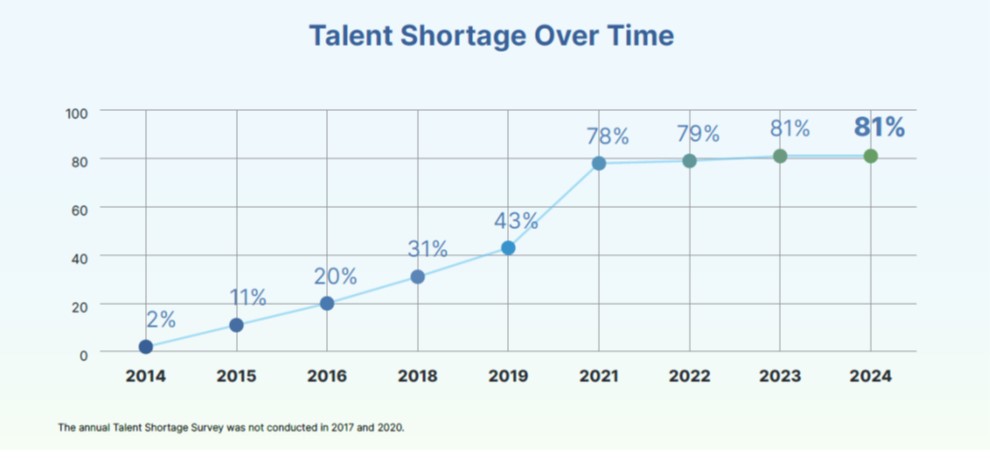
81% of Irish Companies are Finding Talent Attraction Difficult in 2024.

ManpowerGroup Ireland have just released our 2024 Talent Shortage Report where we investigated how difficult Irish employers are finding the hiring market at the moment and their ability to attract skilled talent to their business. Our research shows that 81% of companies are finding it either difficult or very difficult to recruiter key staff in the current market environment. This reflects the current talent shortage in the marketplace with candidates expectations higher in terms of switching behaviour, coupled with low unemployment levels resulting in close to full employment in Ireland and wage inflation still a consideration resulting in a need to be highly competitive in terms of a company's employer value proposition. 

Download Our ManpowerGroup 2024 Talent Shortage Report

Some of the key findings from our 2024 talent shortages report includes:

  • Finance & Property and IT/Technology are the two business industries with the highest talent shortages in Ireland.

  • Dublin is the region with the highest talent shortages.

  • Large companies with over 1,000 employees are struggling the most to find the talent they need for their business.

  • Top HR priorities for 2024 are employee well being and recruiting key staff. One strategy designed to retain staff and the other to attract.

  • Collaboration & teamwork as well as IT & Data skills are the most sought after skillsets in 2024.

  • Employers are implementing a number of strategies to combat and overcome talent shortages with when & where flexibility and creating new talent pools being the most common strategic focus.

Download the Full Report along with the recommended action areas in order to fully align your your recruitment plans with the market in 2024. Reach out to our Talent Attraction Department to discuss any aspect of the report and how ManpowerGroup Ireland can assist with your HR & recruitment needs in 2024.​

Talent Shortage Sector.jpg

Insights

Man Manufacturing Blog Article Desktop 1110x465
Every Manufacturing Challenge Has Become a Workforce Challenge

Every Manufacturing Challenge Has Become a Workforce ChallengeIf there is one thing that feels fundamentally different about manufacturing today compared with just a few years ago, it is the pace and scale of change.Manufacturers are navigating a convergence of forces unlike anything we have seen in decades. Artificial intelligence is moving from experimentation to implementation. Supply chains continue to be reshaped by geopolitical tensions and regionalization. Energy costs remain volatile. Digital transformation initiatives are accelerating. And the competition for skilled talent has never been more intense.What was once a relatively predictable operating environment has become one defined by constant disruption and adaptation.Yet amid all this change, I believe many organizations are missing a critical insight: every manufacturing challenge has become a workforce challenge. We explore this in detail in Manpower’s recent Manufacturing World of Work report. Whether leaders are discussing AI, reshoring, automation, productivity, supply chain resilience, or growth, the conversation eventually comes back to people. Technology may enable transformation, but talent ultimately determines whether that transformation succeeds. This perspective emerged repeatedly in our latest manufacturing research and in conversations with clients around the world. Manufacturers are increasingly realizing that workforce strategy is no longer separate from business strategy—it is business strategy.The Talent Gap Is Becoming a Business ConstraintPerhaps nowhere is this more evident than in the skilled talent shortage.According to ManpowerGroup research, 72% of manufacturers globally report difficulty finding the skilled workers they need. At the same time, manufacturers continue to hire despite economic uncertainty, with a significant proportion planning workforce growth or maintaining current headcount levels.What makes today's talent shortage different is that it has become structural.Around the world, aging workforces are reducing the pool of experienced manufacturing talent while technological change is accelerating demand for new capabilities. Employers are increasingly searching for professionals who combine traditional manufacturing expertise with digital, automation, engineering, and data skills. Yet the talent pipeline has not kept pace with those evolving requirements.Many manufacturing leaders tell me their biggest concern is not simply finding workers, but also whether their workforce can keep pace with transformation itself. They are confronting what feels like a perfect storm: persistent talent shortages, growing skills gaps, retention challenges, and technology advancing faster than organizational capabilities.The result is that talent availability is increasingly becoming a limiting factor for growth, productivity, and innovation.AI Doesn't Eliminate the Talent Challenge, It Changes ItArtificial intelligence is generating excitement and concern across the manufacturing sector.Nearly half of manufacturing workers worry that AI or automation could replace their role within the next two years. At the same time, manufacturers are still moving cautiously with implementation compared to many other industries, reflecting the operational complexity and safety requirements of manufacturing environments.From what I see when I speak with my clients throughout the industrial sector, the reality is much less dramatic than many headlines suggest. AI is not replacing factory workers. It is reshaping work.Routine and repetitive tasks are increasingly being automated, but human expertise remains essential for oversight, troubleshooting, judgment, creative problem-solving, and continuous improvement. Many frontline roles are evolving into higher-value positions that require employees to work alongside increasingly sophisticated technologies.The future-ready manufacturing worker will be part technician and part technologist—a professional who combines hands-on operational knowledge with digital fluency, adaptability, and a commitment to continuous learning.That means AI adoption is not simply a technology initiative. It is a workforce transformation initiative.Manufacturers that focus exclusively on technology investments while underinvesting in people development may struggle to realize the returns they expect.Reshoring Requires More Than New FacilitiesThe same principle applies to reshoring and supply chain regionalization.Around the world, manufacturers are investing heavily in new production capacity closer to key markets. Trade flows are changing, supply chains are becoming more regionalized, and significant investments are being made in strategic sectors such as semiconductors.However, many organizations underestimate one important reality: factories can be built faster than talent ecosystems.Opening a new facility does not automatically create a skilled workforce. In many markets, advanced manufacturing talent is already in short supply, and reshoring initiatives can quickly stretch local labor pools. Building sustainable talent pipelines often requires years of collaboration with educational institutions, workforce partners, community organizations, and government programs.The manufacturers achieving the greatest success are aligning talent strategy with business strategy from the beginning. They understand when to buy talent through hiring, build talent through upskilling, borrow expertise through contingent workforce models, and leverage technology where appropriate.Upskilling May Be the Greatest OpportunityDespite years of discussion about workforce transformation, there remains a significant gap between intention and action.More than half of manufacturing workers report receiving no skills training in the previous six months. At the same time, workers themselves appear ready for change. Most manufacturing employees say they are confident using new technologies and believe they will have opportunities to learn new skills that advance their careers.This finding should be encouraging for leaders.The workforce is often more prepared to evolve than organizations assume. The challenge is not worker willingness—it is creating scalable pathways for learning and development.The most successful manufacturers increasingly treat talent investments the same way they treat capital investments. They recognize that skills are strategic assets capable of driving productivity, resilience, operational performance, and future growth. They invest early in training, workforce planning, internal mobility, and flexible talent models that support long-term competitiveness.In many cases, the highest return on investment comes not from acquiring entirely new talent but from helping existing employees develop the capabilities needed for the next era of manufacturing.The Manufacturers That Win Will Put People FirstManufacturing has entered a period of unprecedented transformation. AI, automation, energy volatility, trade shifts, and reshoring will continue to reshape the industry for years to come.But these forces all point toward the same conclusion.The manufacturers that thrive will not necessarily be those with the newest technology, the largest facilities, or the most aggressive growth plans. They will be the organizations that build adaptable, skilled, resilient workforces capable of navigating whatever disruption comes next.In my experience, the companies successfully navigating today's challenges share a common mindset: they view talent as a competitive advantage, not simply a cost to manage. They understand that every transformation initiative is ultimately a workforce initiative, and they place people strategy on equal footing with business strategy.The future of manufacturing will be shaped by technology. But it will be won by organizations that invest in the people who make that technology work.​

READ MORE
Q3 2026 Meos
ManpowerGroup Ireland Q3 2026 Net Employment Outlook

​ManpowerGroup Ireland Q3 2026 Net Employment Outlook: Hiring Sentiment Softens but Remains Positive​The latest ManpowerGroup Ireland Employment Outlook Survey provides valuable insight into how employers are responding to a rapidly evolving economic and workforce landscape.While Ireland's Net Employment Outlook for Q3 has softened to 12%, the findings reveal a broader story about workforce priorities, hiring strategies, and the future of work.Hiring Confidence Has ModeratedCompared to the previous quarter, employers are approaching workforce expansion with greater caution.The national Net Employment Outlook declined by 23 percentage points quarter-over-quarter and 16 points year-over-year. Importantly, however, hiring sentiment remains positive. The decline follows an exceptionally strong Q2 2026, which recorded the highest second-quarter hiring outlook in more than a decade.Additionally, more than one-third of employers still expect to increase headcount during the quarter ahead. The findings point towards moderation rather than contraction.Employers Are Prioritising Strategic HiringAcross industries and organisation sizes, businesses appear to be focusing on targeted hiring rather than large-scale workforce growth. Manufacturing reported the strongest Outlook at 28%, followed closely by the IT & Tech sector at 25%. These sectors continue to play a critical role in Ireland's economy and remain key drivers of talent demand. At the same time, larger organisations appear to be exercising greater caution, with employers of 5,000+ employees reporting a negative Outlook at -6%.AI and Upskilling Are Driving ProductivityPerhaps one of the most significant findings from this quarter's survey is the growing role of AI and workforce development. Employers identified AI-powered workplace tools and employee upskilling initiatives as the strongest drivers of productivity growth over the past year. As organisations seek to do more with existing resources, investments in technology and skills development are becoming increasingly important. The findings suggest that future workforce success will depend not only on attracting talent, but also on enabling employees to adapt and grow alongside technological change.The Skills Employers Value MostWhen employers were asked which skills they would be willing to pay a premium for, employers highlighted a combination of technical and human capabilities. Communication, collaboration, and teamwork topped the list of soft skills, followed by problem-solving and leadership. On the technical side, Traditional IT & Data skills ranked highest, followed by Operations & Logistics and AI Model & Application Development. Together, these findings reinforce the importance of building a workforce that combines technical expertise with adaptability and strong interpersonal skills.A More Balanced View of the Labour MarketWhile headlines may focus on the decline in hiring intentions, the broader picture is more nuanced. Employers continue to hire, invest in technology, and prioritise workforce development. Strong demand remains in key sectors, and hiring sentiment remains in positive territory. Rather than signalling a downturn, the Q3 results suggest many organisations are taking a more deliberate and strategic approach to workforce planning.Looking AheadAs Ireland's labour market continues to evolve, employers will need to balance economic uncertainty with long-term talent needs. Those organisations that invest in skills, embrace technology, and maintain a clear workforce strategy will be best positioned to succeed. The ManpowerGroup Ireland Q3 2026 Employment Outlook Survey provides valuable insight into the trends shaping hiring, productivity, and workforce priorities across the country.​Download the full Q3 2026 ManpowerGroup Ireland Net Employment Outlook Report here.

READ MORE
Screenshot (3615)
Global Engineering World of Work Outlook 2026

Global Engineering World of Work Outlook 2026From AI to geopolitical uncertainty to sustainability, seven trends are disrupting the engineering talent supply and demand; a buy-build-borrow-bridge strategy can help.Engineering sits at the core of economic resilience, technological progress and everyday life. From critical infrastructure to advanced manufacturing and digital systems, global reliance on engineering capability is accelerating.Yet the workforce model that sustains this capability is under strain. Demand for skilled engineers is growing faster than traditional approaches to talent development, deployment and retention can support. As geopolitical risk, sustainability pressures and digital transformation converge, the gap between engineering demand and available talent is widening.The ManpowerGroup 2026 Engineering World of Work global report explores the megatrends reshaping engineering work worldwide, and the growing mismatch between demand and available talent.​What Are the 7 Engineering Trends We’re Watching?1. Talent Shortages Are DeepeningAcross industries and regions, engineering demand continues to outpace supply.Nearly 73% of employers worldwide report difficulty finding skilled engineering talent. –World of Work Engineering ReportThis shortage is not cyclical — it’s structural. One of the most significant drivers is demographic. While this is a problem across industries and functions, it is acute in engineering. Nine in 10 employers hiring engineers say the retirement of experienced workers is already impacting their HR strategy. As senior engineers exit the workforce, fewer younger workers are entering to replace them, creating gaps in both capacity and institutional knowledge.The result is a global competition for engineering talent that affects timelines, costs, and the ability to deliver critical projects. What was once an HR concern is now a business risk — one that touches innovation, infrastructure resilience, and economic growth.2. AI Augmentation and Skills GapsArtificial intelligence is often framed as a replacement technology, but the report tells a more nuanced story for engineering. AI is increasingly used to automate routine and time‑intensive tasks such as drafting, data analysis, and administrative work, freeing engineers to focus on higher value activities.Eighty percent of employers see the greatest AI‑augmentation opportunities in these areas:Problem‑solvingCreativityTrainingRather than removing engineers from the equation, AI is elevating the importance of:Human judgmentSystems thinkingCross‑functional collaborationAt the same time, AI introduces new risks. Nearly one‑third of employers say their engineers lack the skills to use AI effectively. The engineers themselves have different concerns.76% of engineers and architects worry about skills erosion from over‑reliance on AI tools. – World of Work Engineering ReportThese concerns underscore the need for mentoring, coaching and continuous learning to ensure technology enhances — rather than diminishes — core engineering capabilities.3. Geopolitics and Security Are Driving Specialized DemandGlobal instability is reshaping talent demand, particularly in aerospace and defense. As governments increase investment in security and defense capabilities, the need for engineering talent across the supply chain has surged.Yet according to McKinsey research, the sector faces compounded hiring challenges.Most U.S. aerospace and defense employers (76%) report sustained challenges finding the right engineering talent. – McKinseySkilled‑trade shortages are also acute, with 56% of these employers reporting difficulty filling these roles.In addition, retirement risk is especially acute, with large portions of senior technical talent expected to exit within the next decade.Security clearances, regulatory requirements and long training cycles further restrict the available talent pool. For employers, this means traditional hiring alone is no longer viable. Accelerated training, reskilling and long‑term workforce planning are becoming essential.4. Electrification and Digital Infrastructure Are Accelerating DemandFew trends illustrate the scale of engineering demand better than electrification. From renewable energy and electric vehicles to expanding data centers and digital networks, the global economy is drawing more power than ever before.Global electricity demand is projected to grow more than 3.5% per year on average for the rest of the decade. In the U.S. alone, consulting firm ICF projects an estimated 25% growth in demand by 2030.Global data‑center energy consumption is expected to outpace even demand — doubling by 2030 in North America. – Global World of Work Engineering ReportElectrical engineers play a central role in meeting this demand. Yet supply is lagging. The U.S. already struggles to fill roughly a third of new engineering roles created each year, while countries such as the UK and Japan face projected shortfalls of hundreds of thousands of engineers by 2030. This imbalance places sustained pressure on employers competing for specialized electrical engineering skills.For more about how talent shortages are hindering data center construction and operations, see insights from Julie Loucks, Head of Vertical Strategy for IT and Communications.5. Infrastructure Investment Is Colliding With Engineering Talent ConstraintsAround the world, governments are racing to rebuild and modernize aging infrastructure. Roads, bridges, water systems, energy grids and transport networks all require engineering expertise, particularly from civil engineers.The ManpowerGroup Engineering report estimates that the global economy must invest nearly $4 trillion per year — or about 3.5% of GDP — to future‑proof infrastructure against megatrends such as urbanization, supply‑chain disruption and digitalization.Increasingly common natural disasters in the U.S. have pushed spending higher in recent years according to the American Society of Civil Engineers (ASCE).$9.1 trillion will be needed over the next 10 years to bring all infrastructure up to a “state of good repair.” – 2025 ASCE reportDespite this urgency, 67% of U.S. public‑sector employers say they are struggling to hire civil engineers, intensifying competition between governments and private organizations. Reducing time‑to‑hire, offering flexibility, and strengthening educational partnerships are becoming critical tactics in this high‑demand environment.6. Sustainability and Circularity Are Redefining Engineering’s PurposeEngineering is also central to the global shift toward sustainability. Today’s largely linear economic model — extract, use, dispose — generates massive waste and environmental impact. Transitioning to circular systems presents both a challenge and a major opportunity for engineering talent.A shift toward circular business models could unlock significant economic value.60% of workers say clear environmental action positively influences their job decisions. – Global World of Work Engineering ReportFor employers, sustainability is no longer just a reputational issue — it’s a talent strategy. Organizations engaged in environmentally responsible practices are better positioned to attract and retain the next generation of workers, and engineers are vital to achieving this transformation.7. Semiconductor Expansion Reveals the Limits of Traditional HiringFew industries demonstrate the scale of the challenges ahead more clearly than semiconductors. As a backbone of AI, data centers, autonomous systems, and consumer electronics, the global semiconductor market is expected to more than double by 2030.To support that growth, the industry will need an additional one million skilled workers worldwide. According to McKinsey research, the talent gap in the U.S. is substantial.160,000 more engineering and technical‑support jobs will be needed in the U.S. by 2032 –McKinseyShortages are especially acute at the mid‑career and senior levels, where technical expertise must be paired with leadership and operational experience.In many regions, including the U.S., semiconductor manufacturing is returning after decades of absence, leaving talent ecosystems underdeveloped. The CHIPS for America Act is addressing some of this need with active government partnerships and training programs in several states, but closing the gap will require additional reskilling.What Does It All Mean for Employers?The Global World of Work Engineering Report is clear: engineering‑talent scarcity cannot be solved with a single tactic. Instead, employers must rethink how they attract, develop, and deploy talent.Key strategies include:Retooling employer value propositions beyond payRedesigning early‑career pipelines with structured mentoring and practical trainingAuditing skills regularly to hire for demonstrated capability rather than credentials aloneRetaining and reskilling mid‑career and near‑retirement engineers to preserve institutional knowledgeMost importantly, the report emphasizes a buy–build–borrow–bridge approach — balancing permanent hires, reskilled internal talent and contingent labor through trusted workforce partners to close gaps faster and more flexibly.Engineering Talent Strategy Is Business StrategyThe pressures reshaping engineering — AI adoption, electrification, infrastructure investment, sustainability and geopolitics — are global, interconnected and accelerating. Engineering shortages are no longer isolated challenges; they influence whether organizations can innovate, grow and deliver on critical commitments.Employers that adapt now by investing in skills, reimagining workforce models and partnering strategically will be better positioned to compete in a world that depends more than ever on engineering talent.The question is no longer whether change is coming, but whether today’s engineering‑talent model is ready for it.Get the full picture; Read the full Report here. ​

READ MORE
Ibec 2026 Blog
ManpowerGroup Ireland Named in Top 100 Companies Leading in Wellbeing Index 2026

ManpowerGroup Ireland Named in Top 100 Companies Leading in Wellbeing Index 2026ManpowerGroup Ireland is proud to announce that we have been recognised as one of the Top 100 Companies Leading in Wellbeing Index 2026, an initiative led by Ibec in association with Business & Finance Media Group and The KeepWell Mark.This prestigious index celebrates organisations across Ireland that are leading the way in building healthy, supportive, and high-performing workplaces. Inclusion reflects a strong and ongoing commitment to employee wellbeing, mental health, and positive workplace culture.At ManpowerGroup Ireland, we believe that our people are at the heart of everything we do. Creating an environment where employees feel supported, valued, and empowered is not just a priority—it’s fundamental to how we operate as a business.Being recognised in this year’s index highlights: Our continued investment in employee wellbeing initiatives Our focus on mental health awareness and support Our commitment to fostering an inclusive and positive workplace culture This achievement is a testament to the collective efforts of our teams across Ireland, who contribute every day to building a workplace where people can truly thrive.As we look ahead, we remain committed to strengthening our wellbeing strategy and continuing to support our employees in meaningful and impactful ways.We are honoured to be recognised among organisations that are setting the standard for workplace wellbeing in Ireland.​

READ MORE
Screenshot (3568)
Rethinking Engineering Team Structure

Rethinking Engineering Team StructureWhy scaling engineering today requires more than hiring — and a more flexible approach to how teams are built.​Engineering teams are being asked to deliver more — faster — during a period of uneven but real demand spikes. The Bureau of Labor Statistics projects faster-than-average growth rates for most engineering professions, from 5% for civil engineers to 7% for electrical and electronics engineers.On paper, the outlook is strong. In practice, many organizations are discovering that growth projections alone don’t translate into delivery capacity.The Engineering ShortageThe trouble comes when these robust growth projections meet dwindling supply. The American Council of Engineering Companies (ACEC) estimates an annual shortfall of roughly 180,000 engineers—a gap that shows little sign of closing. Several forces are driving the imbalance:Demographic shifts:As with the broader workforce, more engineers are retiring than entering the field, thinning the mid and senior level talent pipeline.Reduced access to international graduates:Visa constraints mean U.S. universities are training tens of thousands of qualified engineers who are unable to legally work in the U.S. after graduation.Burnout and retention risk:According to ACEC, 47% of engineers cite burnout as their top career concern, ranking ahead of compensation or job security. That signals not just a hiring problem, but a looming retention one.Against this backdrop, simply posting more jobs or offering higher pay often isn’t enough.Why Engineering Team Structure MattersWhen skilled talent is scarce, focusing exclusively on recruiting limits your options. Increasingly, engineering leaders are realizing that team structure itself has become a strategic lever.If your organization has historically relied on an “onsite only” model, it may be worth reexamining that assumption. Data shows that full-time onsite roles take roughly 23% longer to fill than hybrid roles, narrowing an already tight talent pool and slowing time to productivity.In other words, when demand is rising faster than supply, where and how work gets done can either constrain growth — or unlock it.The Three Models: Where Each One Works BestThere is no universally “right” team structure. The most effective models align the nature of the work with the availability of skills, rather than forcing every role into the same mold.Remote-First Engineering TeamsRemote models can be effective for digital-heavy work such as software engineering, simulation, design, documentation and quality assurance. They allow organizations to tap into broader geographic talent pools — particularly valuable for highly specialized or hard-to-find skills.However, remote teams require mature governance, strong documentation, and deliberate collaboration norms to avoid communication breakdowns or quality drift.Hybrid Engineering TeamsHybrid structures have emerged as the default for many scaling organizations. They balance flexibility with in-person collaboration, making them well-suited for teams that span both hands-on and digital work.The risk lies in execution. Without clear expectations, hybrid teams can inadvertently create “two-tier” cultures or collaboration friction. When done well, however, hybrid models often deliver the best mix of speed, resilience, and retention.Onsite-First Engineering TeamsOnsite models remain essential for roles tied directly to equipment, labs, manufacturing environments, fieldwork or regulated facilities. In these contexts, physical presence is not a preference — it’s a requirement.The tradeoff is scale. Onsite-only models restrict hiring to a narrower geographic radius and, in tight labor markets, can significantly slow growth.For tips on staffing a construction project in a geographically remote area, see Addressing Construction Labor Shortages in Rural Areas.Workforce Planning 2.0: Choosing the Right StructureRather than asking which model is best, leading organizations ask a more useful question: Which structure best fits the work we need to deliver?Key considerations for workforce planning include:The degree of hands-on or equipment dependent workSecurity, regulatory or IP requirementsCollaboration intensity across disciplinesWhere critical skills are available geographicallyHow quickly teams need to scale up or down as demand changesThis work-first lens allows organizations to blend models thoughtfully rather than defaulting to blanket mandates.Scaling Patterns That Work Across IndustriesAs demand accelerates across infrastructure, manufacturing, energy, aerospace and technology, several scalable patterns are emerging:Hub-and-spoke models, where onsite teams anchor delivery while remote specialists extend capacityHybrid product pods, supported by onsite “sprint” periods during critical build or launch phasesFollow-the-work models, where roles requiring physical presence remain onsite while digital workstreams operate remotely or hybridThese approaches recognize that scalability comes not from uniformity, but from intentional design.Making Any Model PerformTeam location alone does not guarantee results. High-performing engineering organizations invest just as much in how work flows as where people sit.That includes:Clear governance and quality standardsStrong communication rhythms that favor clarity over meetingsSecure, role-based access to systems and dataManagers who provide direction without micromanagingWithout these foundations, even the most flexible team structure can underperform.Skilled Technical Talent: A Practical Way to Relieve PressureAs engineering teams stretch to meet rising demand, many organizations are turning to skilled technical roles to relieve capacity constraints.Skilled technical roles bridge the gap between engineering and execution. Positions such as engineering technicians, automation technicians, instrumentation technicians and field technicians handle hands-on testing, troubleshooting, calibration and system support, allowing engineers to focus on higher-value design, analysis and problem-solving work.This role clarity reduces bottlenecks, speeds delivery and helps mitigate burnout —especially in hybrid and onsite anchored team structures where physical presence and equipment access are essential.Skilled technical talent is not a substitute for engineers, but a force multiplier. When integrated intentionally, technicians extend engineering capacity, improve workflow efficiency and make scaling more achievable in tight labor markets.When Demand Outpaces SupplyThe effects of accelerating demand and dwindling supply are being felt across the country. One industry report found that 51% of engineering firms have had to turn down projects due to talent shortages. And those that haven’t are facing unexpected delays and escalating costs.The Manpower Engineering DifferenceWhen demand spikes and talent is scarce, the right team structure makes all the difference. Manpower Engineering delivers integrated engineering and skilled technical teams that scale quickly, reduce risk, and keep projects on track. Talk with our experts at [email protected] about a workforce model built for your industry realities.

READ MORE
The Human Edge
The Human Edge

​​Global future of work trendsAs we enter the expanding age of AI, automation and digital integration, the role of humans in work is evolving at an unprecedented pace. In 2026, four key forces will redefine the world of work:Hybrid super teams: Human, machine and freelance talent will reshape traditional hierarchies.Rapid relearning: Continuous skill development will be essential for effectiveness and productivity.Changing norms: Combatting the loneliness epidemic sparked by remote work, geopolitical stability worries and the effects an increased power demand has on the environment.The succession crisis: Ageing leaders will urgently seek the next generation of talent. As the pace of change accelerates, these forces are evolving more rapidly than ever before.​​Explore the full Report here.

READ MORE
Screenshot (3533)
Reflecting on International Women’s Day: Leadership, Allyship, and the Power of Collective Progress

Reflecting on International Women’s Day: Leadership, Allyship, and the Power of Collective ProgressInternational Women’s Day is more than a moment of celebration — it is an opportunity to reflect on the progress we’ve made, the work that still lies ahead, and the role each of us plays in shaping a more inclusive future.Recently, I had the privilege of attending a global webinar hosted by ManpowerGroup, bringing together inspiring voices from across our international community to celebrate this year’s International Women’s Day theme: “Give to Gain.”The session featured a panel of global leaders including Valerie Beaulieu, James Ratna Banerjee, Belén de Mendonça, Ninveh Neuman, Dirco Dekker, and Christopher Pilon, who shared thoughtful insights on leadership, allyship, and the importance of diversity in shaping the future of work.Throughout the discussion, several powerful themes emerged — reminding us that progress is not driven by individuals alone, but through collective action and shared responsibility.A Future Defined by Impact, Not GenderOne of the most compelling reflections from the discussion was a vision for the future of leadership.In time, the goal is that we will no longer speak about male leaders or female leaders, but simply leaders — individuals recognised for their ideas, their influence, and the impact they create.This vision reflects a broader shift in how organisations are thinking about leadership today. When opportunities are accessible to all, leadership becomes less about identity and more about capability, perspective, and contribution.The Strength in Our DifferencesAnother central theme from the webinar was the value of diversity and the strength that comes from embracing different perspectives.Diversity in the workplace is not simply about representation — it is about creating an environment where individuals feel confident bringing their authentic selves to work and where different viewpoints are welcomed.When organisations actively foster inclusive cultures, teams become stronger, more innovative, and more resilient. By learning from each other’s experiences and perspectives, we unlock new ways of thinking and better solutions to the challenges we face.Simply put: we achieve more together.The Responsibility We ShareThe conversation also highlighted the importance of collective responsibility in advancing gender equality.Progress does not happen passively. It requires action from individuals at every level of an organisation — from leaders to colleagues and allies.This can take many forms:Speaking up when we see gender biasAdvocating for equal opportunitiesSupporting and amplifying the voices of othersCreating environments where everyone feels valued and heardThese everyday actions may seem small, but collectively they play a vital role in shaping more inclusive workplaces.Representation, Belonging, and Building ConfidenceRepresentation was another powerful topic discussed during the webinar.When individuals see leaders who reflect diverse experiences, backgrounds, and perspectives, it sends a powerful message: there is space for everyone to succeed.Representation fosters a sense of belonging — and belonging builds confidence.Confidence encourages people to share ideas, pursue opportunities, and contribute fully to the organisations and communities they are part of. In this way, representation does not just impact individuals today; it creates momentum and hope for future generations.Creating the Future Through Today’s DecisionsPerhaps one of the most important reflections from the webinar was the reminder that future generations depend on the decisions we make today.Every action taken to challenge bias, promote inclusivity, and advocate for equality helps build a stronger foundation for the next generation entering the workforce.Progress may not always happen overnight, but consistent action and intentional leadership can create lasting change.Allyship Beyond a Single DayWhile International Women’s Day provides a valuable opportunity to recognise and celebrate progress, the webinar reinforced that meaningful change requires ongoing commitment.Allyship is not defined by a single day or month. It is demonstrated through consistent action — through listening, learning, advocating, and supporting others throughout the year.The theme “Give to Gain” perfectly captures this idea: by supporting one another, championing inclusivity, and investing in equitable opportunities, we create stronger organisations and more empowered communities.Moving Forward TogetherThe insights shared during the webinar served as a powerful reminder that building inclusive workplaces is a shared journey.By celebrating diversity, embracing differences, and working together with purpose, we can create environments where everyone has the opportunity to thrive.International Women’s Day is a moment to reflect — but it is also a call to action.Because when we give our support, advocacy, and commitment to equality, we all stand to gain.​

READ MORE
Screenshot (3507)
ManpowerGroup Ireland Q2 2026 Employment Outlook Report

​Ireland Records Strongest Second-Quarter Hiring Outlook in Over a DecadeIreland’s labour market continues to demonstrate resilience, with employers reporting strong hiring intentions for Q2 2026.The latest ManpowerGroup Employment Outlook Survey reveals a Net Employment Outlook of 36%, highlighting a continued upward trend in hiring sentiment among employers.Key highlights from the report420 employers across Ireland participated in the survey36% Net Employment Outlook for Q2 2026Hiring expectations continues to improve compared with both the previous quarter and last yearMany organisations expect to expand their workforce in the coming monthsThese findings reflect continued optimism among employers despite an evolving economic landscape.Industry outlookThe report highlights notable differences in hiring expectations across sectors.Key insights include:Construction & Real Estate reporting the strongest hiring outlookSignificant improvements in hiring sentiment within Public Sector, Health & Social ServicesContinued workforce demand across several industriesRegional trendsThe survey also highlights regional hiring patterns across Ireland:Munster reporting the most optimistic hiring outlookStrong hiring expectations across major economic regionsContinued workforce demand across Ireland’s key employment hubsEmerging workforce trendsIn addition to hiring activity, organisations are increasingly focusing on future workforce capabilities.The report highlights that:Employers believe AI will deliver the greatest ROI in Learning & DevelopmentOrganisations are prioritising skills development and workforce trainingInvestment in employee capabilities remains a key business priority📊 Gain full access to the ManpowerGroup Ireland Q2 2026 Employment Outlook Report here.📊

READ MORE
Zimmer Biomet Blog
Join Us for the Zimmer Biomet Open Evening in Oranmore

🚀 Join Us for the Zimmer Biomet Open Evening in Oranmore​Are you considering a new career opportunity in Galway? We’re delighted to invite you to attend the upcoming Open Evening at Zimmer Biomet in Oranmore — an exciting opportunity to explore Product Builder roles, meet the team, and experience the site firsthand.​Whether you're actively job seeking or simply curious about a career in medical device manufacturing, this event is designed to give you real insight into what it’s like to work at one of the world’s leading healthcare companies.​📅 Event DetailsDate: March 12thTime: 4:30 pm – 7:30 pmLocation: Zimmer Biomet, Deerpark Industrial Estate, Oranmore, Carrowmoneash, Co. Galway, H91 AE08Pre-registration is essential and can be completed via our online registration form.​What to Expect on the EveningThe Open Evening has been carefully planned to ensure every attendee gets a full experience of the role and the working environment.✔️ Welcome & Check-InUpon arrival, candidates will check in at reception and receive an ID badge.✔️ Site Tour & OverviewOur team will guide you through the facility, giving you a behind-the-scenes look at the manufacturing environment. You’ll also hear short talks about the Product Builder role and what a typical day looks like.✔️ Meet the TeamYou’ll have the opportunity to meet Supervisors and members of the hiring team, ask questions, and learn about career progression opportunities.✔️ On-the-Spot InterviewsPre-registered candidates will take part in a short interview during the evening.Successful candidates will be invited to complete a DAT assessment test, which will be issued either later that evening or the following morning.​Why Attend?This Open Evening is more than just a recruitment event — it’s your chance to:Gain real insight into a global medical device companySee the working environment for yourselfUnderstand the expectations and progression pathwaysMake a strong first impression with the hiring teamTake the next step in your manufacturing careerProduct Builder roles offer stability, structured training, and the opportunity to contribute to products that genuinely improve patients’ lives worldwide.​Who Should Attend?We welcome candidates who:Have an interest in manufacturing or medical devicesAre detail-oriented and enjoy hands-on workAre looking for long-term career opportunities in GalwayThrive in team-based environmentsPrevious manufacturing experience is beneficial but not essential — attitude, reliability, and willingness to learn are key.​How to RegisterSpaces are limited, so early registration is strongly encouraged. Find the registration link here: https://form.jotform.com/260431710339046For more information or to register your interest, please contact:📧 [email protected] look forward to welcoming you on March 12th and helping you take the next step in your career with Zimmer Biomet.​

READ MORE